Creative Biolabs is offering the most comprehensive services for antibody development projects. With strict regulation and effective execution, we are dedicated to providing the most valuable solutions to complete your projects.
HighlightsCreative Biolabs is offering the most comprehensive services for antibody development projects. With strict regulation and effective execution, we are dedicated to providing the most valuable solutions to complete your projects.
HighlightsCreative Biolabs has established a broad range of platforms for developing novel antibodies or equivalents. These cutting-edge technologies enable our scientists to meet your demands from different aspects and tailor the most appropriate solution that contributes to the success of your projects.
HighlightsWith deep understanding in antibody-related realms and extensive project experience, Creative Biolabs offers a variety of references to help you learn more about our capacities and achievements, including infographic, flyer, case study, peer-reviewed publications, and all kinds of knowledge that can assist your projects. You are also welcome to contact us directly for more specific solutions.
HighlightsGet a real taste of Creative Biolabs, one of the most professional custom service providers in the world. We are committed to providing highly customized comprehensive solutions with the best quality to advance your projects.
HighlightsBovine (cow) antibodies represent a paradigm shift in antigen recognition, distinguished by an exceptionally long third complementarity-determining region of the heavy chain (CDRH3). This "ultralong CDR3," often exceeding 50 amino acids, forms a unique "knob-and-stalk" structure, enabling it to penetrate and bind to cryptic or recessed epitopes that are inaccessible to standard human or murine antibodies. Creative Biolabs stands at the forefront of antibody engineering, offering a world-class Bovine Antibody (with Ultralong CDR3) Humanization Service. We harness the unprecedented targeting capabilities of bovine antibodies and meticulously engineer them to minimize immunogenicity for clinical applications, transforming these remarkable molecules into potent therapeutic candidates.
The bovine immune system has evolved a unique architectural solution for its antibody repertoire. Unlike the V(D)J recombination in humans and mice that primarily generates diversity in CDR3 length and sequence, cattle utilize a single VH gene segment and a limited number of DH segments. To compensate, they generate extraordinary diversity through somatic hypermutation and extreme junctional diversification, resulting in a significant portion of their antibodies possessing ultralong CDRH3 loops.
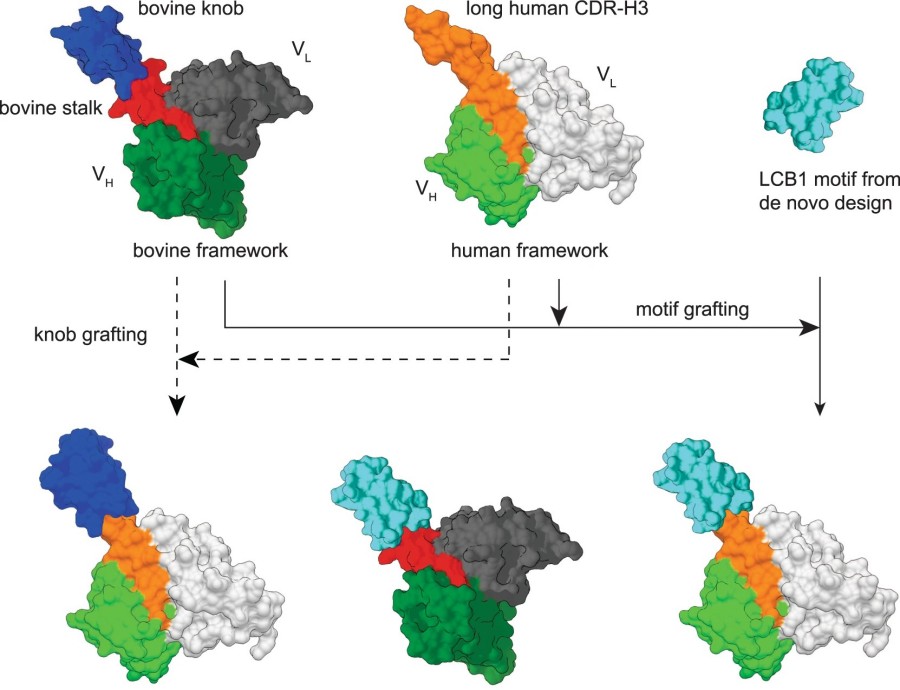 Fig. 1 Design principles for the development of bovine and human antibodies with ultra-long CDRs.1
The unique structure of bovine antibodies translates into significant therapeutic advantages:
To address these unique challenges, Creative Biolabs has developed the Bovine Antibody Humanization platform, a sophisticated, multi-pronged approach that combines advanced computational modeling with proven protein engineering techniques. Our platform ensures the highest probability of success in generating a safe, stable, and potent humanized bovine antibody.
| Feature | Advantage |
| Structure-Based Design | Our reliance on high-resolution 3D modeling minimizes trial-and-error, increasing the success rate and preserving native affinity and specificity. |
| Proprietary Framework Library | Access to a curated library of human frameworks allows us to find the optimal structural match for your unique ultralong CDR3. |
| Multi-Parameter Optimization | We simultaneously optimize for low immunogenicity, high affinity, high expression levels, and excellent biophysical stability. |
| Deep Expertise | Our team has decades of collective experience in antibody engineering and has overcome the specific challenges associated with non-traditional antibody formats. |
| Comprehensive Reporting | You receive a detailed report including all sequences, expression data, and full biophysical characterization results. |
| Flexible and Customizable | Our services are tailored to your specific project needs, from initial feasibility studies to full-scale development and manufacturing. |
The unique targeting ability of humanized bovine antibodies opens up new therapeutic possibilities across numerous disease areas:
To support your entire antibody development pipeline, we offer a comprehensive suite of related services:
Leverage Creative Biolabs' deep expertise and state-of-the-art Bovine Antibody Humanization platform to develop next-generation biologics. Our dedicated team of scientists is ready to partner with you to overcome the most difficult antibody engineering challenges.
Q: How much sequence identity can be achieved with a human antibody?
A: Our Bovine Antibody Humanization platform typically achieves over 90-95% sequence identity with human germline frameworks in the variable regions, significantly reducing the risk of immunogenicity.
Q: Will the humanization process affect the antibody's affinity?
A: Our primary goal is affinity preservation. Our structure-guided approach, which includes careful framework selection and strategic back-mutations, is designed to retain the binding affinity of the parental bovine antibody. We validate this with rigorous biophysical testing.
Q: What materials do I need to provide to start a project?
A: Ideally, you would provide the amino acid or DNA sequence of the variable heavy (VH) and variable light (VL) domains of your bovine antibody. If you only have the hybridoma cell line, we can perform sequencing as an initial step.
All listed services and products are For Research Use Only. Do Not use in any diagnostic or therapeutic applications.